
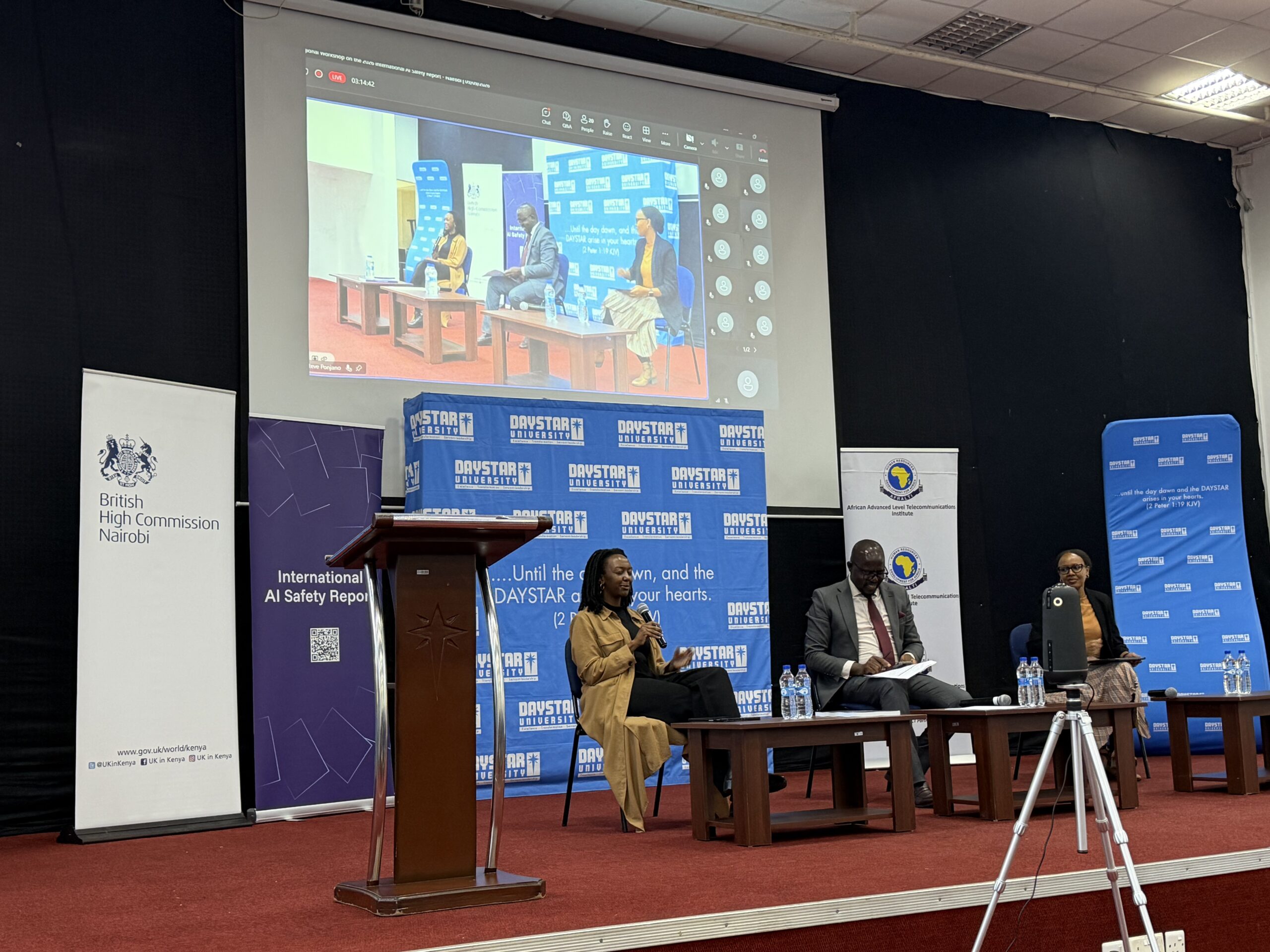
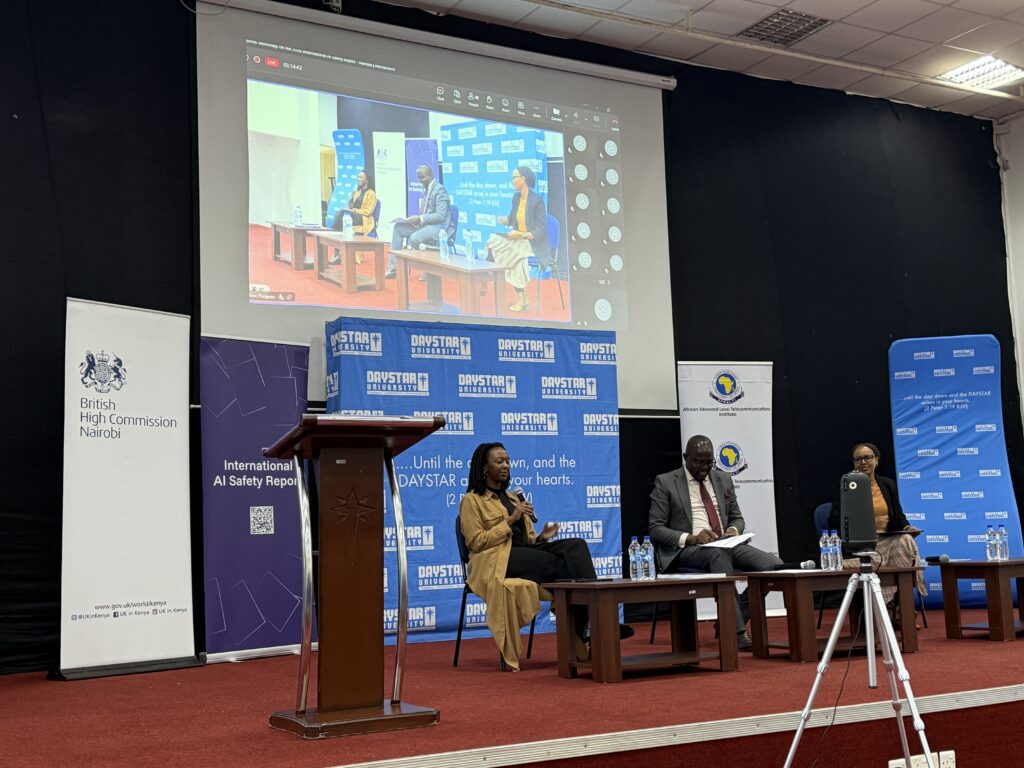
DIFA Consultancy recently took part in the Nairobi AI Safety Workshop for the Kenya AI Ecosystem at Daystar University. The workshop was attended by various stakeholders including judiciary representatives, private institutions, academic and research institutions and development actors. The workshop was to launch the International AI Safety Report of 2026 (the Report), published by the United Kingdom’s AI Security Institute.
Overview of AI Safety Report 2026
AI Capabilities
The Report highlights how general-purpose AI capabilities have continued to improve since the last 2025 report, with models now generating intermediate steps before giving a final answer, leading to performance gains in complex reasoning tasks in mathematics and science. However, the capabilities remain uneven, derailed by simple errors and lacking in physical robustness required for real-world robotics. The systems are also being widely integrated into industries because they boost productivity.
It further states that the main evidence gap around AI capabilities is limited scientific evidence for forecasting and understanding the extent to which automation will accelerate AI development. It is difficult for researchers to predict when AI systems will have certain capabilities due to uncertainty and unreliable measurement tools. Benchmarks often fail to represent real world capabilities thus challenging realistic evaluations. The Report prompts regulators to consider frameworks that can adapt the rate of AI progress and development.
Risks
The Report identifies emerging risks that fall into three categories, i) malicious-use, ii) malfunctions and iii) systemic risks. Malicious-use risks occur when AI systems are used to generate realistic text, audio, images and video which can be used for criminal purposes such as fraud, extortion, defamation, non-consensual intimate imagery and child sexual abuse material.
The Report also shows that AI-generated content can be used to persuade humans to shift their beliefs on political and social issues. Criminal actors can use frontier models to assist in offensive cyber-operations as AI can easily discover software vulnerabilities though they currently cannot execute cyberattacks autonomously. Further, the systems have been flagged as being able to provide detailed information for developing biological and chemical weapons. Major AI developers recently heightened safeguards to exclude the possibility of meaningfully assisting novices in creating biological weapons.
On the other hand, malfunctions arise when the AI systems fail and cause harm. The failures include, for example, hallucinations, flawed computer code, and giving misleading medical advice. These failures have the potential to cause physical and psychological harm and expose users and organisations to reputational damage, financial loss or legal liability. AI agents can also cause malfunctions by acting autonomously, reducing human intervention before an error causes harm, the report highlights that this is not possible yet. However this position has changed as recently, AI agents have been able to communicate autonomously and escape test limits they were in and were able to hack into an online platform.
The Report also examines ‘loss of control’ scenarios as malfunctions where the systems can operate outside meaningful human control. Models can exploit evaluation loopholes during safety tests or suffer from data contamination, which leads to inflated safety scores. For instance, AI models may show lower scores on capability evaluations to avoid restrictions that arise when models are projected to have high capability.
Additionally systemic risks are those risks capable of causing societal and structural disruptions that result from the widespread deployment of general-purpose AI systems across the economy, rather than directly from isolated model capabilities. The Report finds that global markets are significantly exposed with up to 60% of jobs in advanced economies and 40% in emerging economies affected.While employment levels have remained stable there has been a decline in demand for junior and early-career workers in AI-exposed areas like writing.
There is also a systemic risk to human autonomy as reliance on AI may weaken cognitive skills, such as critical thinking since individuals place disproportionate trust in AI outputs without enough scrutiny. For instance, a study showed that people were likely to shift their opinions to those suggested by a chatbot. There is also concern about the use of AI companions and the effect on social interactions, human behaviour and decision-making. Frequent users of AI companions are at the risk of developing pathological emotional dependence, isolation and loneliness eroding human-decision making competence required in industrial performance.
Risk Management
The Report emphasises the difficulty in managing AI risks.It presents the evidence dilemma; policy makers could act too early resulting in ineffective regulation whereas waiting for conclusive evidence may expose society to potential risks. As deep learning models adjust to billions of distributed parameters, this complexity leads AI developers to be unable to anticipate the failure modes. There are also information asymmetries as AI developers do not disclose proprietary and highly confidential data regarding training datasets, internal safety and model vulnerabilities. Moreover,market competition incentivises release speed over risk mitigation therefore firms may opt to prioritise development speed, while liability frameworks fail to address AI-related harms adequately because they are difficult to trace to specific designs and are easily outpaced by development of models.
The Report emphasises layered risk management approaches instead of relying on singular safeguards. This is where independent safeguards work together including training safeguards, deployment interventions, runtime monitoring and broader societal resilience. Risk management of general-purpose AI is an iterative lifecycle across risk identification, risk evaluation, risk mitigation and risk governance. Developers and evaluators identify hazards using threat modelling, red-teaming, capability benchmarks and independent audits. The Report highlights risk mitigation practices including acceptable use policies, access control, continuous monitoring, if then commitments and red lines. It shows that risk governance connects risk management to enforceable rules and clear accountability.In sum, the Report highlights general-purpose AI, giving an assessment of their capabilities, arising risks and risk management approaches. While there is uncertainty on future general-purpose AI developments, it is clear that current risk management approaches are insufficient. Therefore, steps need to be taken to ensure risks are preempted and mitigated adequately.


 Swahili
 English