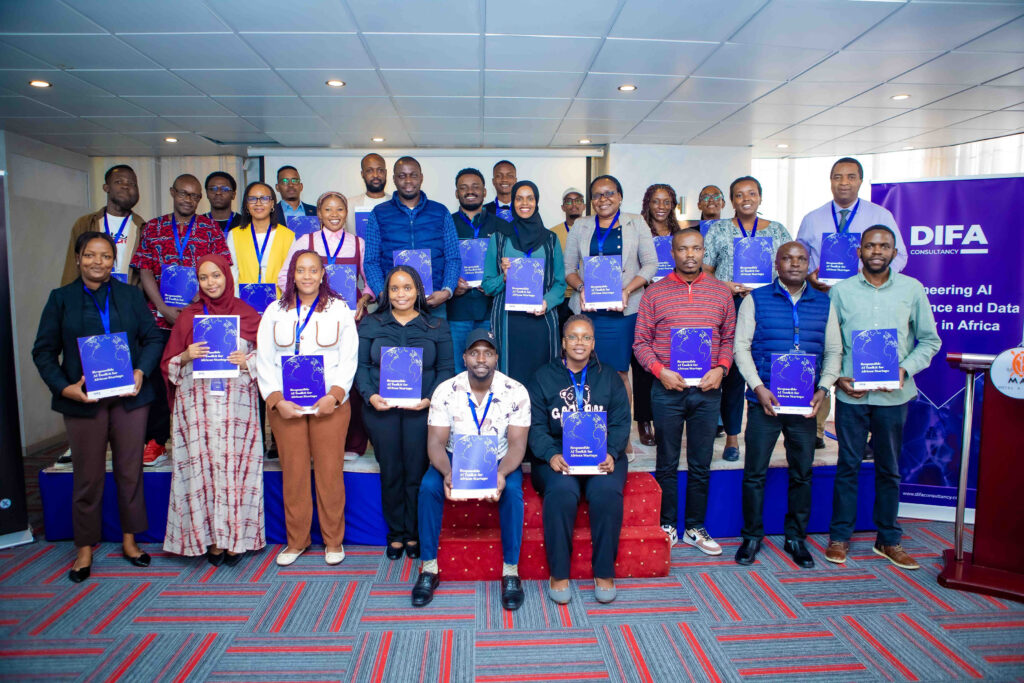
Between 16 – 17 March 2026, DIFA Consultancy, in partnership with Akili AI and KICTANet, and with support from the British High Commission, convened a Training of Trainers (ToT) for startups on Responsible AI in Nairobi. The ToT brought together 20 participants from 14 innovation hubs, SMEs, and startups across Kenya, including Garissa, Kakamega, Kiambu, Kilifi, Kisumu, Kitui, Laikipia, Machakos, Makueni, Mombasa, Murang’a, Nairobi, Nakuru, Uasin Gishu, and Wajir.
The two-day training focused on strengthening capacity on the responsible design, development, and deployment of AI systems, combining foundational sessions on AI ethics, legal compliance, data governance, and AI risk assessment with practical, hands-on exercises. Participants explored key issues covering algorithmic bias, data protection, accountability, and transparency in the AI lifecycle, regulatory challenges relating to emerging AI concerns in intellectual property, and the need for contextually relevant AI solutions that respond to local realities.
A major highlight of the ToT was the launch of the Responsible AI Toolkit for African Startups on Day 2 (17 March), a practical resource designed to support startups, SMEs, and innovation hubs in integrating responsible AI principles, legal compliance, and risk assessment into AI development and deployment processes. Through case studies and guided exercises, participants applied the Toolkit to real-world scenarios, strengthening their ability to identify risks and implement mitigation strategies.
The impact of the ToT was also reflected in participant feedback:
“This training has been wonderful and an eye opener, especially … covering the principles of responsible AI deployment, the regulatory and compliance components, and also looking at the technical risks that we need to assess and mitigate when deploying AI.” Dr. Hilda Muteshi, SUS AFRIC Innovators Ltd
The ToT further provided space for reflection on ecosystem challenges, including limited access to quality data, capacity gaps, and the perception of Responsible AI as a compliance burden. Discussions emphasised the importance of shifting toward viewing responsible AI development and deployment as a strategic enabler for trust, innovation, and sustainable growth.
As a key outcome, participants committed to cascading the Toolkit within their networks, supported by a growing community of practice. The ToT marked an important step in advancing practical, responsible AI implementation in Kenya, and in the region, reinforcing the role of collaboration, capacity building, and locally grounded solutions in shaping an inclusive AI future for African startups.
 English
  Swahili