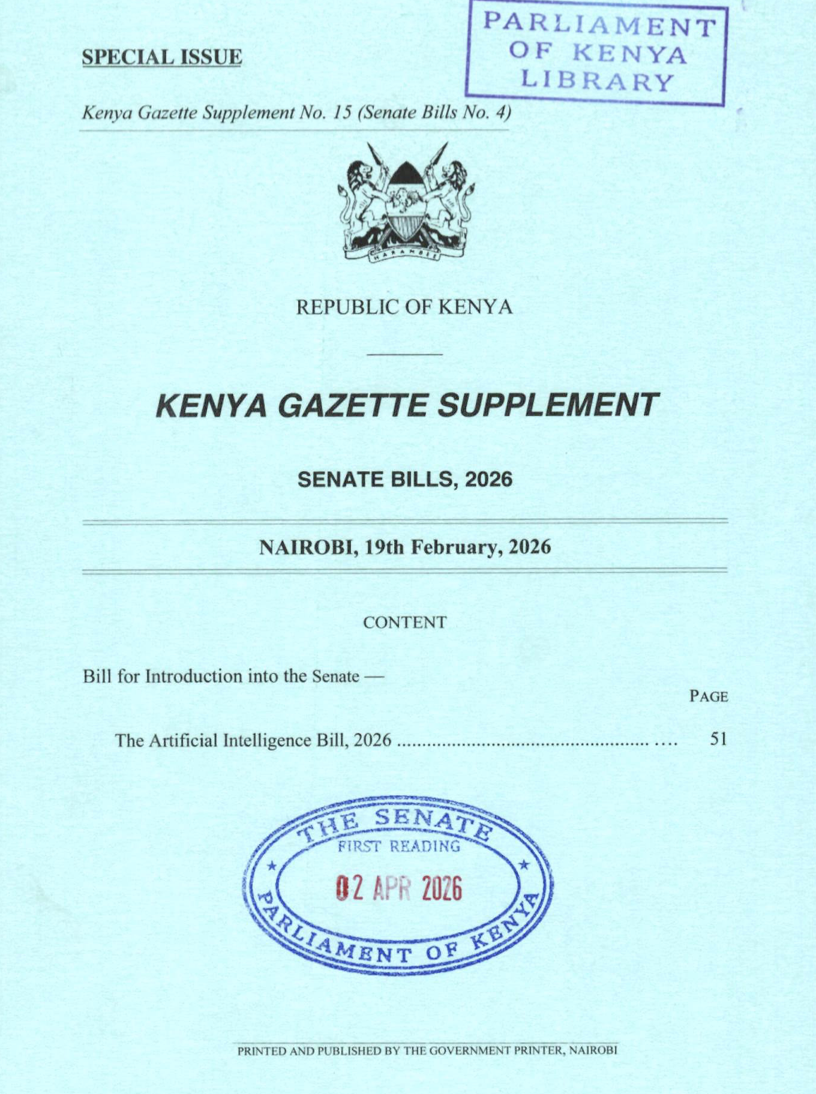
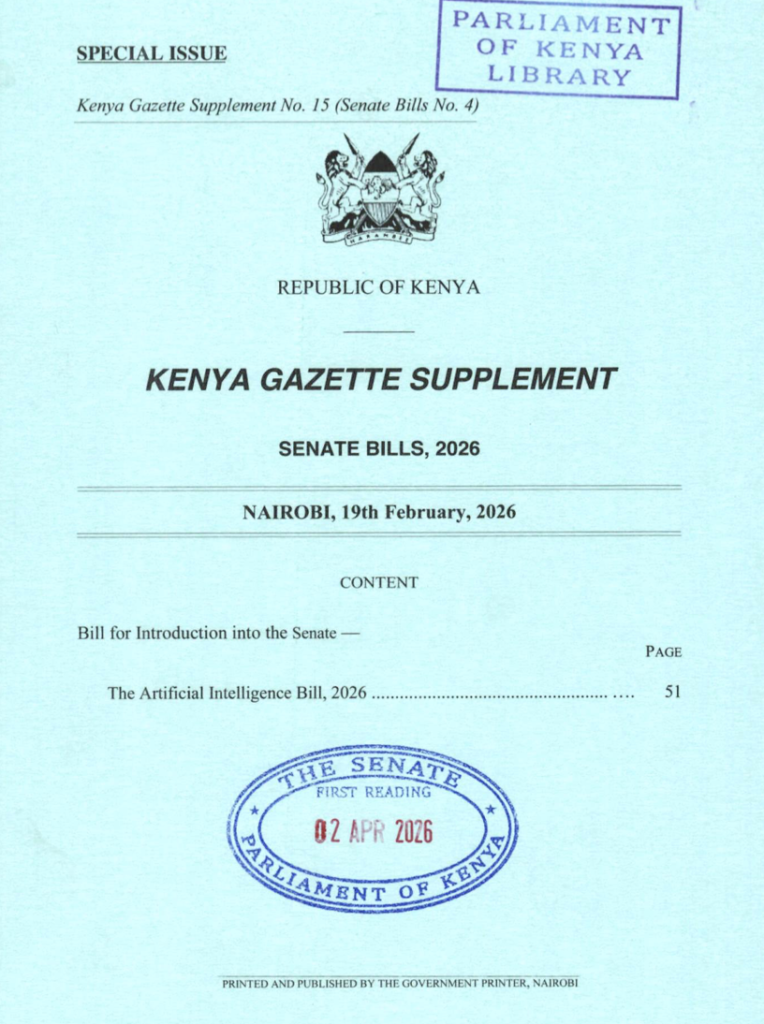
The Kenya Artificial Intelligence Bill, 2026 (the Bill), is a legislative proposal designed to establish a comprehensive framework for the regulation and governance of artificial intelligence (AI) in the country. In summary, the Bill aimed at regulating AI systems, defines AI as a machine-based system capable of operating with varying levels of autonomy to generate outputs such as predictions, content, or decisions.
Highlights of the Bill’s Provisions
The Bill highlights its objectives which are to provide a framework for the regulation and governance of AI in Kenya to ensure the ethical, transparent and accountable use of AI, while safeguarding human rights, data protection and public welfare. Specifically, the Bill states that it aims to foster AI innovation while promoting AI literacy and ensuring alignment with international standards on AI.
It also seeks to put in place dedicated institutional oversight and advisory bodies over AI in Kenya by establishing two primary institutions:
- The Office of the Artificial Intelligence Commissioner: this is an independent state which will be responsible for overseeing the implementation and enforcement of the Act, and is tasked with conducting risk assessments, performing conformity audits, and managing regulatory sandboxes for safe testing;
- The Advisory Committee on Artificial Intelligence: a multi-disciplinary committee, composed of stakeholders from government, private sector, civil society and other experts, whose responsibility will be to advise the Commissioner on emerging trends and opportunities. The Committee will review and provide recommendations on guidelines, standards and regulations proposed under the Act, facilitate stakeholder engagement on AI matters, promote multi-disciplinary research and collaboration on artificial intelligence governance, among other responsibilities.
Similar to regulatory regimes in other jurisdictions such as the European Union and its AI Act, the Bill introduces a risk-based governance structure to categorize AI systems. AI systems are classified into four tiers: unacceptable risk (which are prohibited), high-risk (such as those used in healthcare, education, or security), limited risk, and minimal risk, with high risk AI systems carrying the highest compliance burden including conducting human rights impact assessments (HRIA), and ensuring explainability of decision making processes.
The Bill also mandates transparency across all AI system risk categories, requiring that users be informed when they are interacting with AI, while granting individuals the right to human intervention and the ability to contest automated decisions that significantly affect them.
To ensure compliance, the Bill prescribes various offences, including operating prohibited “unacceptable risk” systems or failing to conduct mandatory workforce assessments. Depending on the severity of the offence, sanctions range from financial penalties to imprisonment, or both.
Implications for the Kenyan AI Regulatory Space
In addition to the ongoing development of the Kenya AI and Emerging Technologies Policy, the Bill creates a new layer of governance on local or foreign AI system actors operating in Kenya. It introduces a new risk- based classification necessitating compliance obligations based on risk level, including the establishment of the Office of the AI Commissioner to enforce these rules with sanctions prescribed for non-compliance.
Within the AI ecosystem in Kenya, concerns have been raised on whether these provisions may adversely impact the innovation sector within the country by imposing burdensome compliance requirements. Stakeholders have highlighted that the legislation that aims to put in place binding legal obligations may be going ahead to regulate an AI market that is still in the early phases of maturity.
At this stage, the Bill is undergoing consideration through the legislative process, required at both national and county levels, after which the regulatory direction for Kenya’s AI journey will become clearer to the AI ecosystem.

 Swahili
  English